The Assistant Editor Is the Most Endangered Job in Post
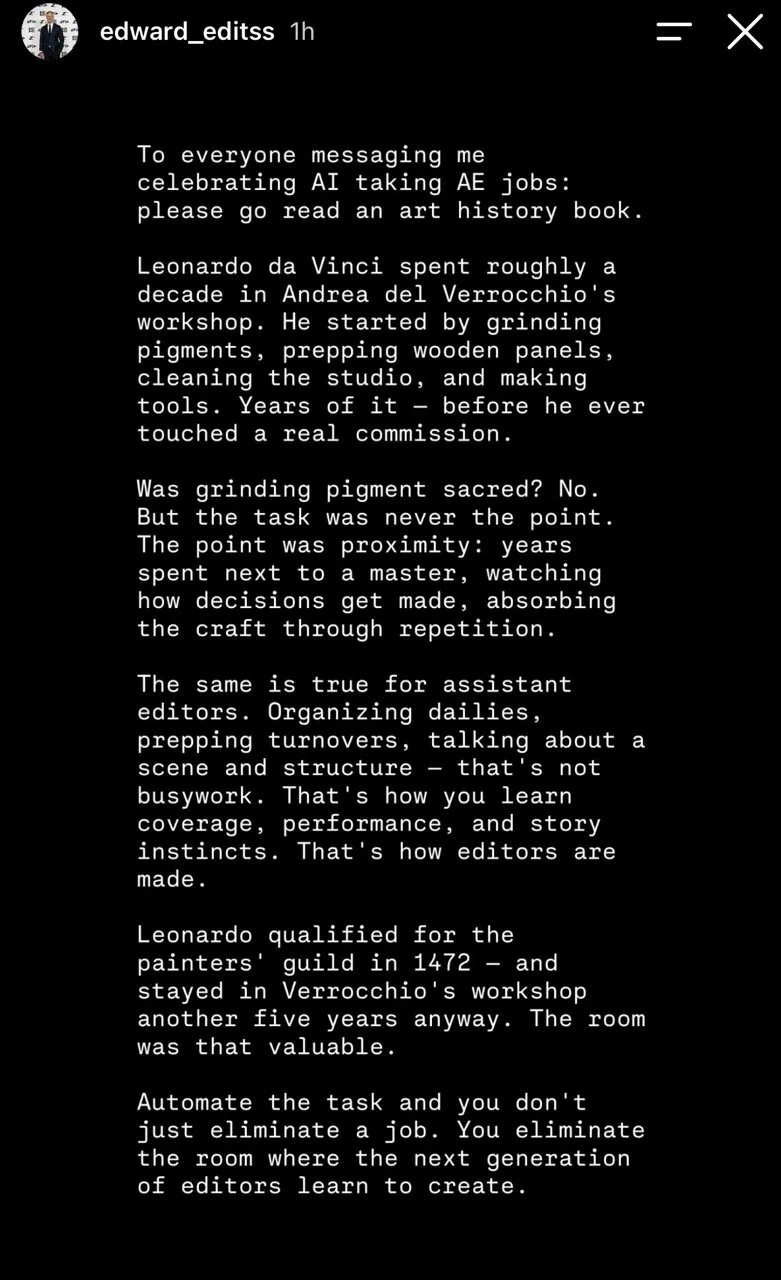
The assistant editor track has always been brutal. Early mornings ingesting media. Long nights syncing dailies. Hundreds of hours organizing bins that an editor blows through in a single session. Most of it invisible. Very little glory. But here's the thing: that invisible work was never really about the tasks. It was about the craft knowledge you absorbed while doing them.
And that's what's could disappear with AI.
AI is coming for the assistant editor role first. Not the editing. Not the creative decisions. The exact job that, for decades, turned aspiring editors into actual ones. And it’s a real concern whether you use or don’t use AI.
The Assistant Role Was Always the Real Film School
The traditional path into editing isn't film school. It's the cutting room. You get a job as a post PA or an assistant, you sit next (or next door) to an editor, and you learn. Not from a manual, from proximity. You watch them wrestle with a sequence that isn't working, find the fix, and move on. They challenge you to ask the WHY’s and not just the HOW’s. You absorb the muscle memory of real decision-making without even realizing you're doing it.
This can be complicated by remote work today as assistants aren’t physically in the room as much which creates a bit of a gap, but I fully believe great mentors and editors know how to teach in this type of environment too. I will say that remote learning, even though it’s what I have championed in my own career, isn’t a full trade off of value vs being in person. In person learning will always be very important to early development.
Beyond the mentorship, assistant editing tasks themselves had hidden educational value. Syncing dailies forced you to understand camera coverage. You couldn't match audio to picture without knowing which angle was which and why a director called for it. Organizing bins made you think about how footage would be used before a single cut was made. Pulling selects required you to actually watch everything, form opinions, and start developing taste.
Nobody talked about it this way. It was just "the work." But the work was the education.
Now the Work Is Being Automated
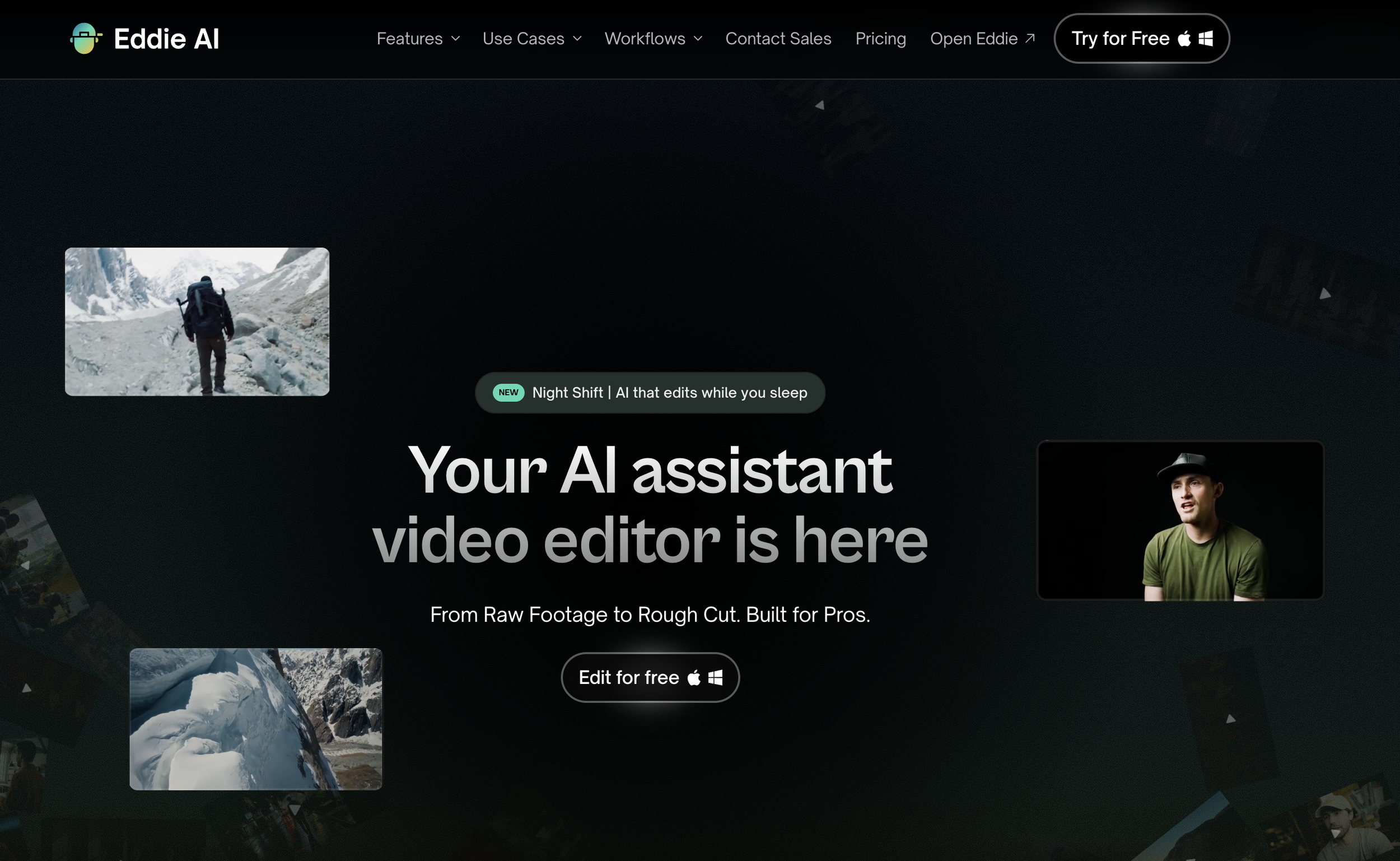
AI tools are replacing the process. Take a look at Eddie AI which is (depending on how you look at it) a direct threat to the assistant editor in the traditional sense. It just one of many tools including what AVID and Adobe are building within their own systems.
Frame-accurate syncing is being handled by software that takes seconds where a human took hours. Rough selects can be pulled by AI based on transcript keywords. The tasks that used to define an assistant editor's day are getting picked off one by one.
I'm not going to pretend that's all bad. I've spent enough late nights manually syncing multicam shoots and typing metadata into a library catalog to be a hypocrite about it. But the question nobody is asking loudly enough is this: if you automate the work, what happens to the learning that came with it?
Don’t get me wrong either. I’m not fully anti-AI. The technological advances can really help assistants and editors. I think tools that help us tell stories more efficiently while protecting a path for the industry’s future talent is the answer. But with studios trying to make more with less or cutting schedules because AI saves time, it’s going to be an uphill battle. These tech companies are very good at creating narratives like we do in the edit bay. “AI saves thousands of hours”, “AI will change humanity!”, “AI can do the things Hollywood creatives never could.” But like all good storytelling, many things are embellished.
I Know What I Missed by Skipping the Track
My path wasn't traditional. I'll be the first to say it. I went from intern at NFL Films to logger at NASCAR Productions, then jumped almost straight into cutting at SPEED Channel until ultimately landing in long form docs and indie scripted. I was editing on my own very quickly.
It wasn't until I started taking on higher-budget work that I realized how much I didn't know. Especially as I tried to focus on more of a scripted path. Codebooks. Turnovers. How to run a proper dailies workflow. The systems that assistant editors on bigger shows take for granted because they learned them on the job. I had to go back and teach myself everything I'd bypassed. Cold emailing assistants, digging through forums and wikis, taking jobs specifically to learn how it was really done.
In fact, this approach led to my current feature doc New Here directed by Dan Sickles. I started out as the AE trying to learn the standard assistant workflow within AVID to prepare for more scripted work and now I’m credited as editor and associate producer. But it was a big educational experience on so many levels.
I wrote about this in my free Post Production Resource Guide. A huge part of why that guide exists is because I had to build my own curriculum from scratch. The community saved me, but I had to go looking for it. Not everyone will know to do that.
The traditional assistant path isn't glamorous, but it delivers something structured self-study or AI can't fully replicate: time, volume, and accountability in a real production environment. That's hard to manufacture on your own. Trust me, I know.
What This Means for the Next Generation
I serve on the NYC ACE internship committee as an ACE affiliate member. Every year, we read letters from people trying to break into this industry. Many I speak to personally on Zoom. These are people who are hungry, talented, and looking for the kind of hands-on experience the assistant track used to provide. What I see more and more is that the path in is narrowing at exactly the moment more people want to take it. And no one knows what to do.
Production volume is down. Remote editing workflows are cheaper, and now AI is eating the entry-level tasks. The apprenticeship model is under real pressure from all ends. And when the assistant role gets hollowed out, the craft knowledge it transferred doesn't vanish automatically. It just stops being passed down.
The editors I know who came up through proper assistant work have a fluency with the technical side of post that's hard to describe. They know how to manage a turnover package under pressure. They've been in rooms where things went wrong and watched how experienced people handled it. That kind of knowledge is unmatched and doesn't just come from a YouTube tutorial.
But more importantly outside of the technical skillset, in this environment assistant editors get to know the reasoning behind the decisions in the edit bay. Especially when you have a quality mentor. When I first started talking with editors in the community, I found many had insight from mentors that I never got. It was eye opening. I still write down as much as I can when hearing great quotes. This is where the assistant has such a leg up. You can talk through the emotional decisions an editor makes when they make them. You hear feedback live and see solutions develop. That’s hard to come by and worth protecting for future talent.
So What Do You Do Knowing that AI is a Direct Threat To That?
If you're trying to break in right now, you don't necessarily get to wait for the traditional path to reopen. You have to build your own version of the education it used to give you automatically.
From a technical POV that means actively seeking out dailies workflows even if nobody's handing you a show. Learning codebooks, syncing procedures, and turnover processes, not because a job requires it yet, but because an editor someday will assume you already know. It means finding the community that still holds this knowledge: the groups, events, organizations, forums, the wikis, the working assistants who are generous with what they know. There are more of those people than you think, and most of them will answer a thoughtful cold email.
For the craft side of things, dive into as many books and films that you can. I’ve helped curate that list already. Listen to editors speak on podcasts. Study as much as you can, but also try things. Download footage online and cut it up. Reach out to editors whose work you enjoy with thoughtful questions. Convince you professors to reach out to ACE as they have a new ACE Editing Experience where you can download actual dailies from amazing shows and films.

For any editors reading this trying to figure out how they can help up-and-coming assistant editors in this new era of AI, I believe just taking an anti-AI stance and holding strong isn’t always helpful. Some of these tools can free up an assistant’s or post PA’s time so they can actually learn the things that matter like how to shape performance or structure a story. Or honestly just sit and watch an editor. Plus in this new era, those assistants or Post PA’s may not even have a choice to not participating in the AI era. It’s what studios are pushing for. Like everything in life, I think it needs to be a balance and writing people off who use the tech isn’t the most helpful. It’s up to us to try to facilitate the future of the next generation of film editors and have these conversations in a safe way. We have to educate filmmakers, studios execs, and teams why the assistant editor role is important. I’ve been recently hiring new talent on smaller projects and find creative ways to help them even if that means I take a little bit of a profit hit from my own salary to help pay them. Helping someone find an opportunity is a major priority for me now more than ever before. I’m committed to that process for as long as I can be helpful for people.
The assistant editor role may be endangered and for the first time in a long time, the people who want to learn it are going to have to find it themselves in many ways. Luckily, I’ve done a lot of that work for you to get started. Follow me on IG to stay in touch on new things, but also head over to my post resource guide to start learning now! It’s completely FREE!